Your company's memory.
A company that knows itself.
And software you can finally trust to run it.
Every contract term, promise, decision and outcome on one record that cannot quietly go wrong — so the software standing on it can finally be trusted with the work.
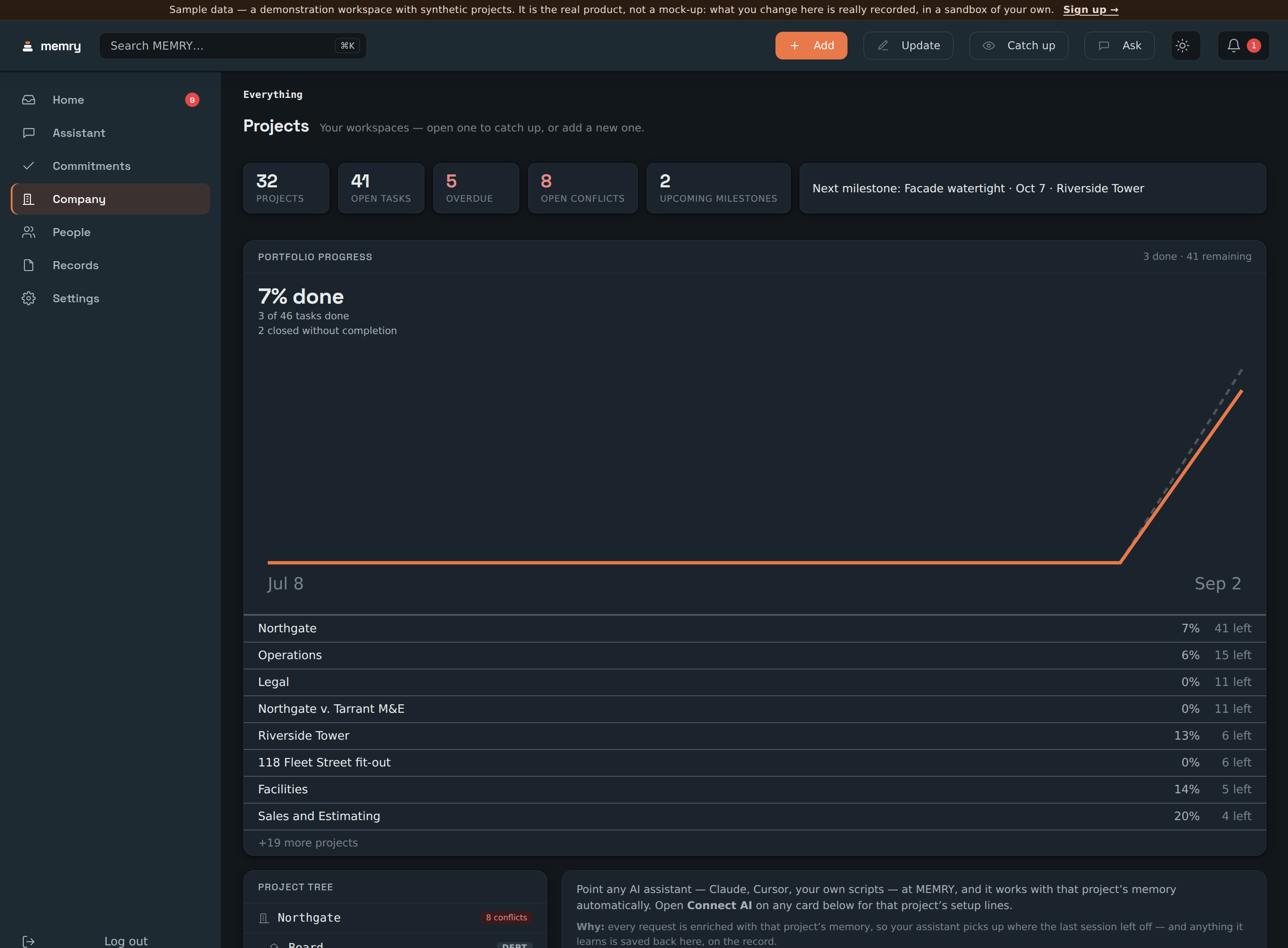 The whole company, one screen
Not a mock-up. This is the demo workspace as it opens, and you can be in it in one click.
The demo opens on a whole company, already running.
What it takes off your desk
The admin does itself. You approve it.
Most of a working week is not the work. It is chasing a status somebody already gave, re-reading a contract to find one number, writing the update, and remembering the thing nobody wrote down. A record this reliable can do that part for you.
It files, you approve
Send it the contract, the email, the site report. It reads them and puts the promises, dates and decisions in front of you as a queue to approve. You are checking, not typing. The document keeps its own words underneath.
It tells each person their own bit
Not a dashboard everyone ignores. One queue per person: what needs you, what is due, what you have been asked about, and what moved overnight on anything you are watching. Nobody has to go looking.
It writes the update
The status report, the catch-up on everything that moved since you last looked, the answer with the document behind it — drafted out of the record and filed where it belongs. You change a line and send it.
It notices before you do
An overdue task, a deadline that moved, a certificate expiring mid-programme, an engineer who has gone quiet, a leaver still holding eleven promises. Flagged the moment it happens, on the day you sign up.
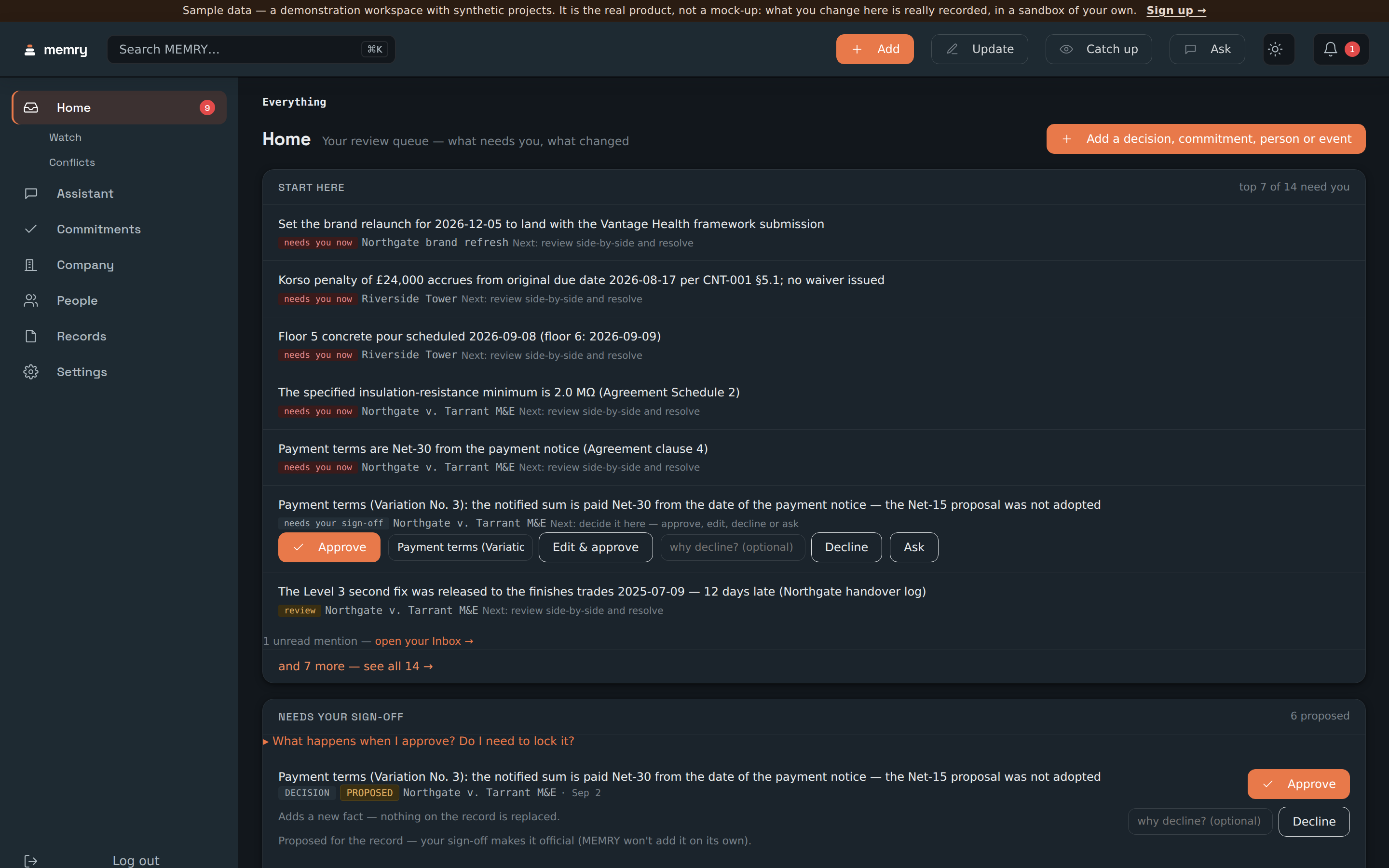 From the demo company
One person's queue. Everything on it was read out of something that arrived, and every row is one click from approved, edited or declined.
Why nobody else can do this
Reading the contract is the easy half.
Plenty of software can read your documents and find the clause. None of it can tell you whether the thing in that clause actually happened — because nothing else keeps the outcome next to the promise that made it.
What was agreed
Every contract term, invoice, valuation and decision, with the reasoning that settled it. Read out of the document that states it, and the sentence is kept — so any number opens at the words it came from.
What is happening now
Who is holding what, what is late, what moved this week, what is waiting on somebody who does not know it yet. One live picture, instead of nine status reports written on a Friday afternoon.
What actually happened
Every date a person called, and whether it landed — kept as counted history rather than as an impression. This is the half nobody else has, and it is the half that turns a record into management.
Memry remembers every decision, every promise, and every document — and tells you when something doesn't add up.
That is what closes the circle. A tool that only reads documents can tell you what was promised. A tool that also knows outcomes can run the place — chase the supplier who is genuinely going to be late rather than the one who has merely gone quiet, believe the date that has earned belief, and answer “are we exposed here?” with the record instead of a meeting.
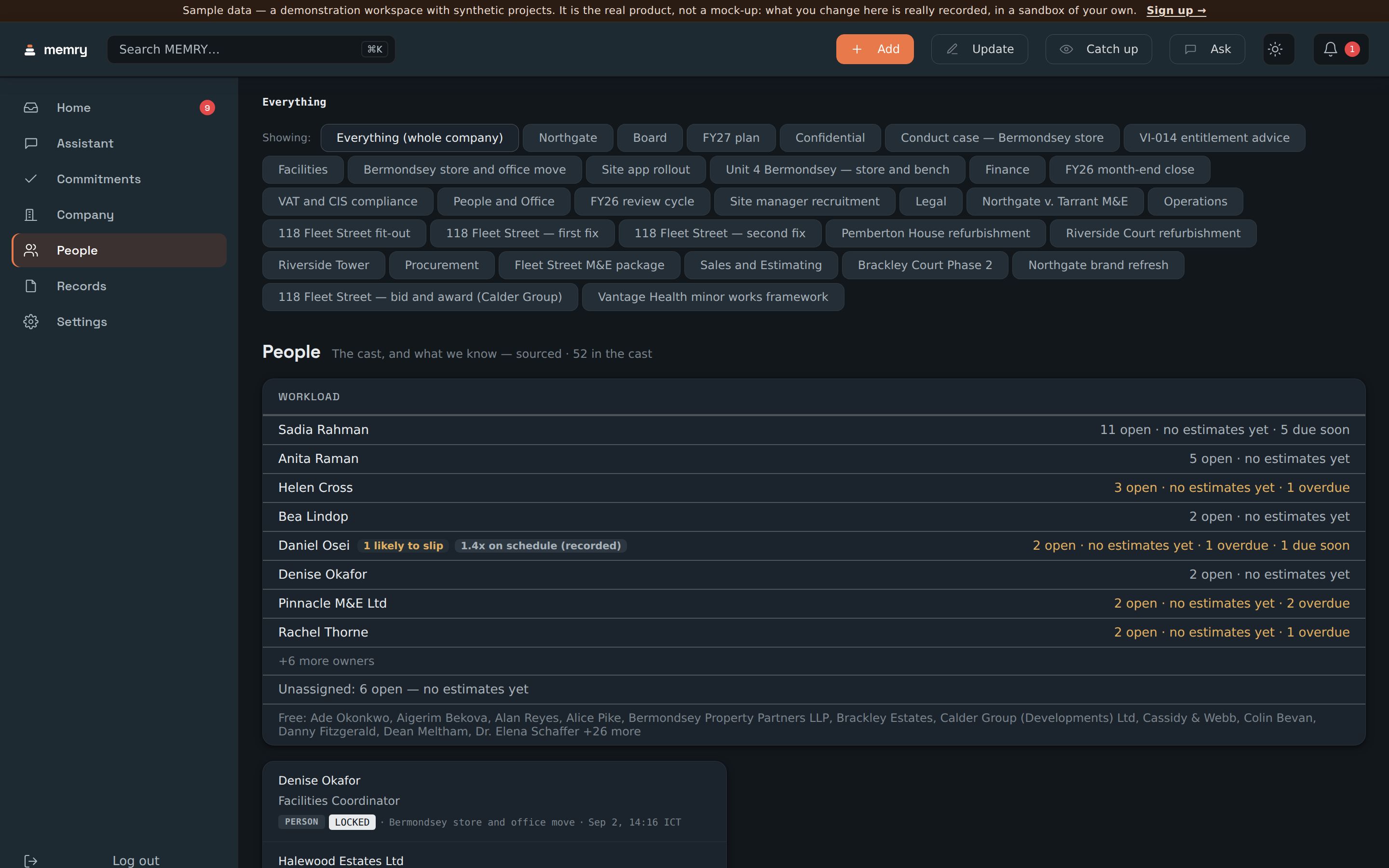 From the demo company
Outcomes, kept. Not an opinion about who is reliable — a count of the dates each person actually called, against what actually happened.
Why this has not existed before
It cannot be quietly wrong.
Software has been able to do a company's work for years. What it has never been able to do is know the company — well enough, and reliably enough, to be trusted with any of it. Point an AI at a folder of documents and it will tell you the payment terms with total confidence, because it has no way of knowing which of the four versions it found is the one that counts.
Memry is the part that was missing. Every fact in it has a source you can open, a standing you can see, and a history you can wind back. Nothing becomes true because a machine sounded sure. Nothing settled gets overwritten without a person saying so, and when two records disagree the disagreement is put in front of somebody rather than resolved in the dark.
The promise is not that Memry is never wrong. It is that it can never be quietly wrong. That is a much rarer thing, and it is the whole reason the rest of this is possible. In practice it means four specific behaviours:
- When two records disagree, it stops and shows you both, each with the document it came from. It does not merge them, take the newer one, or ask a model to adjudicate.
- Nothing already settled changes without a person with the authority saying so — and the engine checks that, not the button.
- Nothing is ever deleted. Retiring a fact is a change of status, so the record can answer “what did we believe in March”, not only what it believes now.
- It keeps a record of what it refused to do. Most systems cannot tell you what they turned away, because they never turned anything away.
Nobody compared these two. Memry did, and refused to overwrite the locked one.
What that makes possible
An AI you can actually put in charge of something.
This is the part that has never been available before, and it is not a bigger model — it is a record worth pointing one at. Every AI can write you a confident paragraph. The reason none of them can be trusted with your company is that none of them can tell the difference between a term that was agreed and a term somebody floated in an email. Memry's assistant runs on a record where that difference is a permanent property of every fact.
It answers out of the record
Ask it anything about the company and the answer comes back with the documents underneath it — click any number and the page opens at the sentence it was read from. If it does not know, the record says so rather than the model filling the gap.
It proposes; you sign
It can open the task, log what happened, draft the report, move the date. All of it arrives as something waiting for your yes, in one queue, with what it would change shown before it changes.
When it is wrong, it is stopped
Ask it to change something already settled and it does not get to. The attempt is refused and parked as a disagreement for a person to rule on — the AI tries, the record holds. You can watch it happen in the demo.
You can see the difference it makes
Ask the same question twice, once against the company's memory and once without it, side by side. That comparison is a screen in the product, because the gap between the two answers is the entire argument.
Most of it needs no model at all
Noticing an overdue promise, an expiring certificate or a decision short a signature is the record and a rule — ordinary deterministic software. A model is only involved in writing prose. So the parts that catch things keep working whether or not you ever set a key.
The key is yours
Your provider, your model, your spend, visible on your own bill and switchable the day something better appears. We do not buy model capacity and resell it to you inside a seat price with a margin you cannot see.
Put those together and the shape of the working day changes. The inbox stops being a to-do list somebody maintains in their head at eleven at night, and becomes an outbox that gets approved.
One record, every altitude
The company, the project, the team, the person.
The same memory read at whatever height you need it. Nobody re-enters anything to move between them, and nobody has to learn the other three.
The company
Every project on one screen with its own counters — open, overdue, contested, due next — and a catch-up that tells you what moved since you last looked.
The project
Its own dashboard laid out the way you want it, a board, a calendar, a timeline of the milestones, the budget, the time booked against it, and the documents it was built from.
The team
Everyone inside and outside the company, what each of them is holding right now, how much of it is late, and how their past dates actually turned out.
The person
One queue: what needs you, what is due, where you have been mentioned, and what changed overnight on anything you are watching.
What it catches
Five things it does that nothing else does.
All five are on screen in the demo, on a real company, in about three minutes.
Nothing falls through the cracks.
Memry reads what arrives and picks out the promises, dates and decisions in it. You approve them — you do not file them.
Every fact has a receipt.
Click any number and the document opens at the sentence it came from. Not a summary — the passage.
It catches what nobody compared.
An invoice says Net-14. The contract says Net-30. Memry will not quietly overwrite the contract.
Know whose "on track" to believe.
Your site manager says on track. Here are his last several dates, against what actually happened.
It tells you, before you ask.
A certificate expiring mid-programme. Nine days of silence from an engineer. A leaver still holding eleven promises.
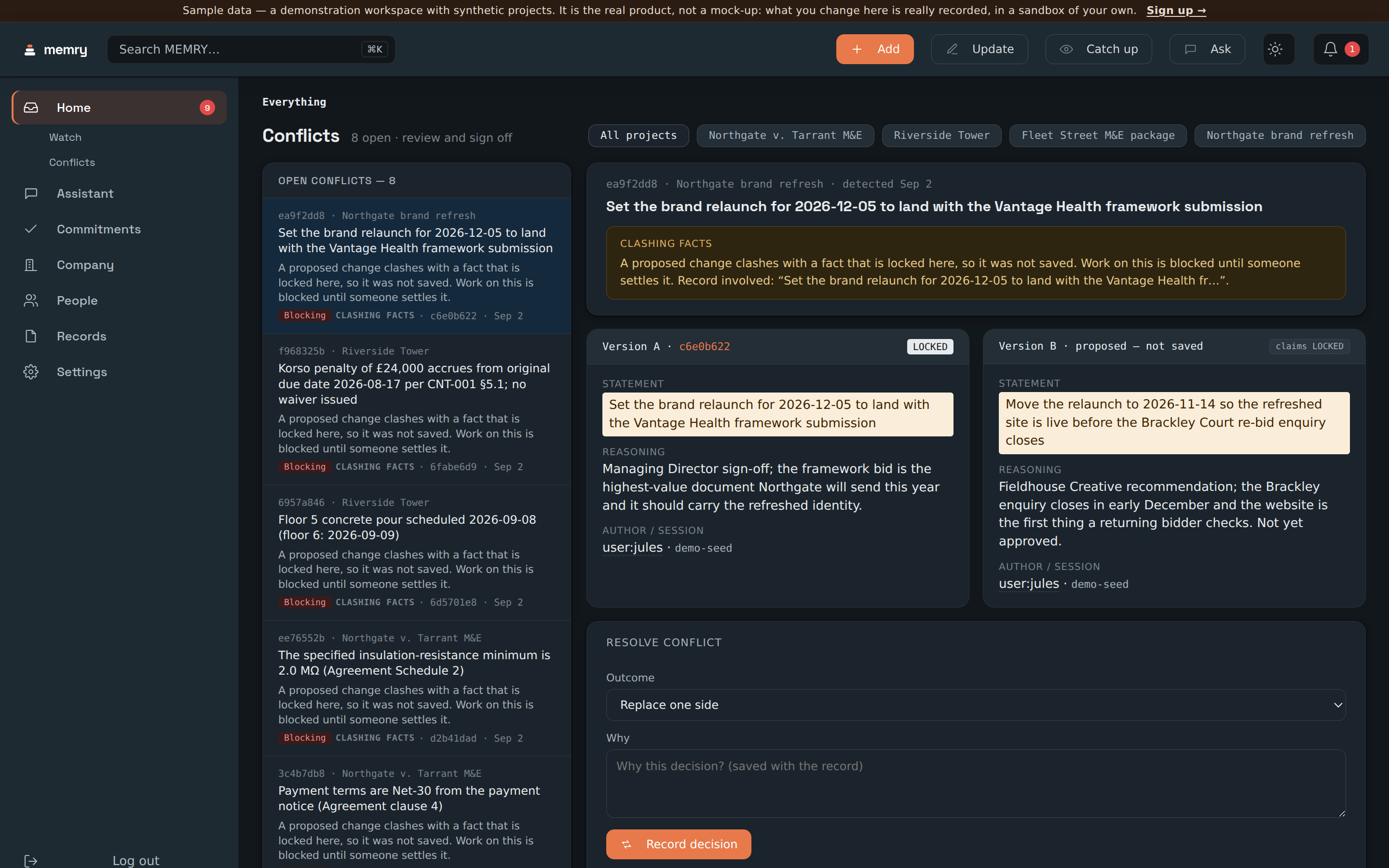 From the demo company
The clash above, on screen: the locked date beside the one that would have overwritten it, each with the document and the person it came from — and the form to settle it.
Everything you'd expect
The basics are all there.
Nobody moves their company onto a clever feature. So this is a whole tool — everything below ships today, and each of these is better than its equivalent elsewhere for standing on a record that cannot quietly change underneath it.
Work
Projects and tasks with owners, due dates and templates that match the way your industry actually runs a job.
Views
A home queue, a due list, a watch list, and search across every record and every document body at once.
People
A roster of everyone inside and outside the company, what each of them is holding, and how reliable their past estimates turned out to be.
Documents
Files with their real bodies stored, quoted passages behind the facts, and a link from any fact back to the sentence it came from.
Money
Contract sums, invoices, valuations and payment terms — read out of the documents that state them rather than typed in twice.
Meetings
What was decided and who committed to what, captured as records you can act on rather than a transcript nobody re-reads.
Reporting
A catch-up on everything that moved since you last looked, and a full export of the trail in JSON or CSV whenever you want it.
Automation
Starter rules that flag an overdue task or a moved deadline the moment it happens, on the day you sign up.
A complete project and company management tool — work, people, money, documents, meetings — with a memory no other tool has.
Built for companies whose records have to hold up:
Construction Legal Professional services Is it us? →The whole point
Go and break it.
It is a real workspace with a real company in it, and it is yours — change anything you like. Nobody else sees your copy of it.
Explore the demo → No account needed. About ninety seconds to see the point.Start your own company
Three questions at signup, then Memry scaffolds the company around your industry and your size, and puts you in it as the owner.
Signing up is by invitation for now, so the form asks for an invite code.