Who it's for
Any company that runs on agreements.
Which is all of them. Contracts, customers, suppliers, invoices, meetings, deadlines and people who eventually leave — if your company has those, Memry is a better way to run them, and the memory underneath is why.
What every company already has.
None of this is exotic. It is the ordinary furniture of running a business — and in most companies it is scattered across four inboxes, a shared drive, a folder on somebody's laptop and two people's heads.
Contracts and their terms
Payment terms, rates, notice periods, penalty clauses. Read out of the document that states them, so the number opens at the sentence.
Customers and suppliers
Everyone inside and outside the company, what each of them is holding, and how their past dates actually turned out.
Obligations with dates
Who owes what to whom, by when. Not a task list that dies with a mailbox — a promise with a counterparty and a deadline.
Invoices and money
Contract sums, valuations, applications and what was actually approved, next to the decision that authorised the spend.
Meetings and decisions
What was settled and who committed to what — as records you can act on, rather than a transcript nobody re-reads.
Email and documents
The things that arrive all day carrying facts nobody has time to file. Memry reads them and proposes; you approve.
Deadlines that move
Programme dates, renewals, certificates, notice windows. Flagged when they move, and chased against whoever they are waiting on.
People who leave
And the promises they were holding. Those survive them, because a commitment is a record rather than something in somebody's inbox.
Every company keeps this record already. The question is only whether it is kept somewhere a machine can use — and whether you can trust what it says when it matters.
It pays for itself on ordinary days
Most of the value is not the dramatic save. It is the status you did not have to ask for, the report you did not have to write, the number you did not have to go and look up, and the thing that got flagged before it became anybody's problem.
The problem gets worse with success
A company doing three jobs remembers them. A company doing thirty does not, and the moment it stops remembering is not marked by anything — no alarm, no missing file. It shows up much later, as an argument.
And the bad day is covered too
Nine times out of ten the forgotten agreement costs nothing. The tenth time it is a penalty clause, a payment term, an expired certificate or a date somebody moved without telling anyone. You cannot tell in advance which is which — but you do not have to think about it, because the record was kept as the work happened rather than assembled afterwards.
The shape of company it suits
Enough going on that no one person holds all of it. Not so much back-office that anybody has time to maintain a system for its own sake.
Memry is built for the middle. If keeping the record is somebody's second job — and in most companies it is somebody's fourth — then it has to be nearly free, which means the record has to build itself out of the things that were arriving anyway.
The demo is deliberately that size — a portfolio of live projects across several parts of a business, with a couple of dozen people and firms attached to it, and a stack of documents behind the whole thing. It is not a toy with four tasks in it, because a tool that works on four tasks tells you nothing.
You will not be asked to model your company before you can use it. Signing up asks three questions, and Memry scaffolds a starting structure you can rename, remove or accept as it stands.
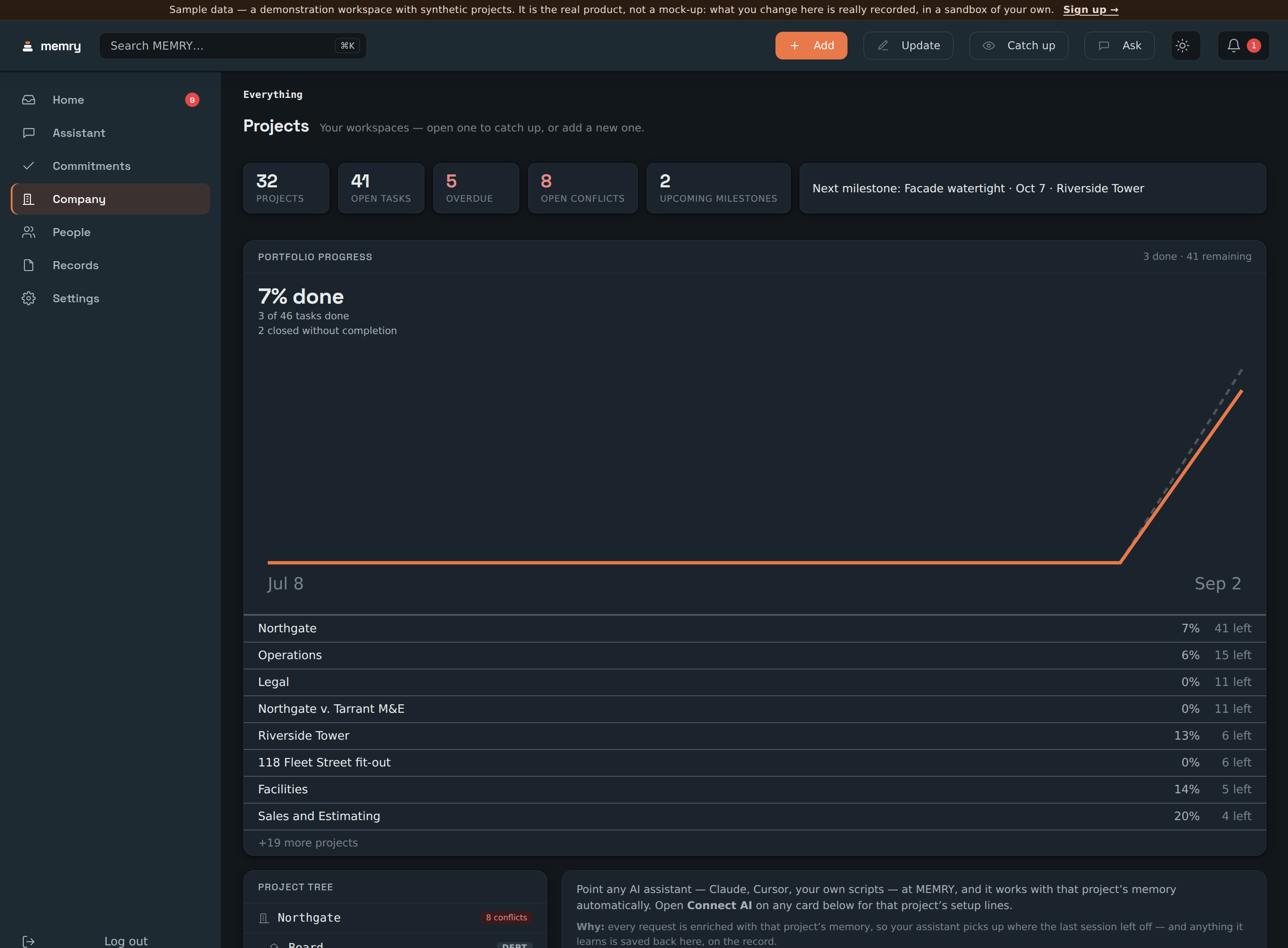 From the demo company
Thirty-one live projects across several parts of one business, and the eight disagreements sitting inside them.
Who actually opens it, and what for
Three different jobs, one record underneath them. Nobody has to learn the other two.
The person running the work
Opens the queue, approves what is right, and gets told when a date moves or a task goes past due. Their screen is a list of things that need them today, in order.
What changes for them: they stop being the place the company's memory lives.
The person who owns the outcome
Wants the portfolio on one screen, wants to know which promises are at risk and whose dates have historically held. Opens the catch-up on a Monday and reads what moved.
What changes for them: “on track” stops being an opinion they have to price.
The person who has to prove it
Needs the document, the passage and the date — in an argument, an audit, a claim or a handover. Follows a fact back to the sentence it came out of and exports the trail.
What changes for them: the search takes a minute instead of a fortnight.
Three starter sets
Memry is not industry software. It ships a starting structure for three kinds of company so that day one is not an empty screen — and everything in it can be renamed or removed.
Construction →
Payment terms, instructions, certificates and programme dates, kept against the document that stated them. Four project types and the roles a site actually works through, ready at signup.
Legal →
Matters, positions and the paper behind them, with every fact traceable to the passage it came from. Four matter types and the roles a firm works through, ready at signup.
Professional services →
Engagements, scoped promises and what was agreed with a client. Runs on the general starter set rather than a tailored one — that page says so plainly and explains what it means.
If none of the three is you, the general set is the honest answer — and it is what the third page above is running on. The record, the receipts and the disagreement handling are identical in all three; only the starting furniture differs.
Who it is not for
Said here rather than discovered three weeks in.
Anyone wanting it to decide
Memry raises disagreements and refuses to overwrite locked facts. It never picks a side. If what you want is a system that resolves things automatically so nobody has to look, this is the opposite of that.
Teams whose work leaves no trace
If the agreements live entirely in conversation and nothing is ever written, there is nothing for Memry to read. It closes the gap between written and remembered — not between said and written.
Anyone who needs it today, at scale, hosted
Signing up is by invitation for now, so the form asks for an invite code. The demo needs neither, and it is the whole product.
Anyone shopping on price
Pricing is not yet published. What is already settled about the commercial model is on the pricing page.
The fastest way to answer this question
Go and look at a company like yours.
Ninety seconds in the demo will tell you whether this is your problem better than any page can. It opens on a working company with real disagreements in it, and it is yours to break.
Explore the demo → No account. No invite code.