For professional services
What you promised, and what it actually cost.
Consultancies, agencies and practices run on commitments made in passing — in a call, a thread, a corridor. Memry catches them as they arrive, keeps each one with the message that made it, and tells the person who owes it before the client does.
One thing to be straight about first
Two industries have catalogues built for them today: construction and legal. Everything else, including consulting, accountancy, agency and design work, lands on the general pack. We would rather tell you that here than have you find it on the second screen.
Adding a catalogue is content rather than code, so a professional-services one can arrive without a migration and without waiting for a release. If you would use one, it is worth telling us what belongs in it.
What is not affected by any of this: the record, the receipts, the disagreement handling, the track records, the watch list, the trail and its export are identical whichever pack you start on. The pack is furniture. The memory is the product.
What the memory is worth on an engagement
Six places the gap between what was agreed and what got written turns into money.
Creep with a paper trail
The extra thing agreed in a Thursday call is a record with the sentence that agreed it — which is the difference between a variation and an argument.
Client conventions that outlive staff
How this client wants a deliverable formatted, invoiced and approved stops being one account manager's private knowledge.
Estimates with a track record
Whether a lead's “two weeks” has historically meant two weeks, taken from their own past estimates rather than from a feeling — and marked unknown where there is no history yet.
Nothing lost at handover
When a project changes hands the promises come with it, already written down and already attached to their evidence.
Money against the document
Fees, invoices and payment terms read out of the engagement letter that states them, and raised when a later document disagrees.
A catch-up that is actually a catch-up
What moved since you last looked, across every engagement, without opening eleven threads to find out.
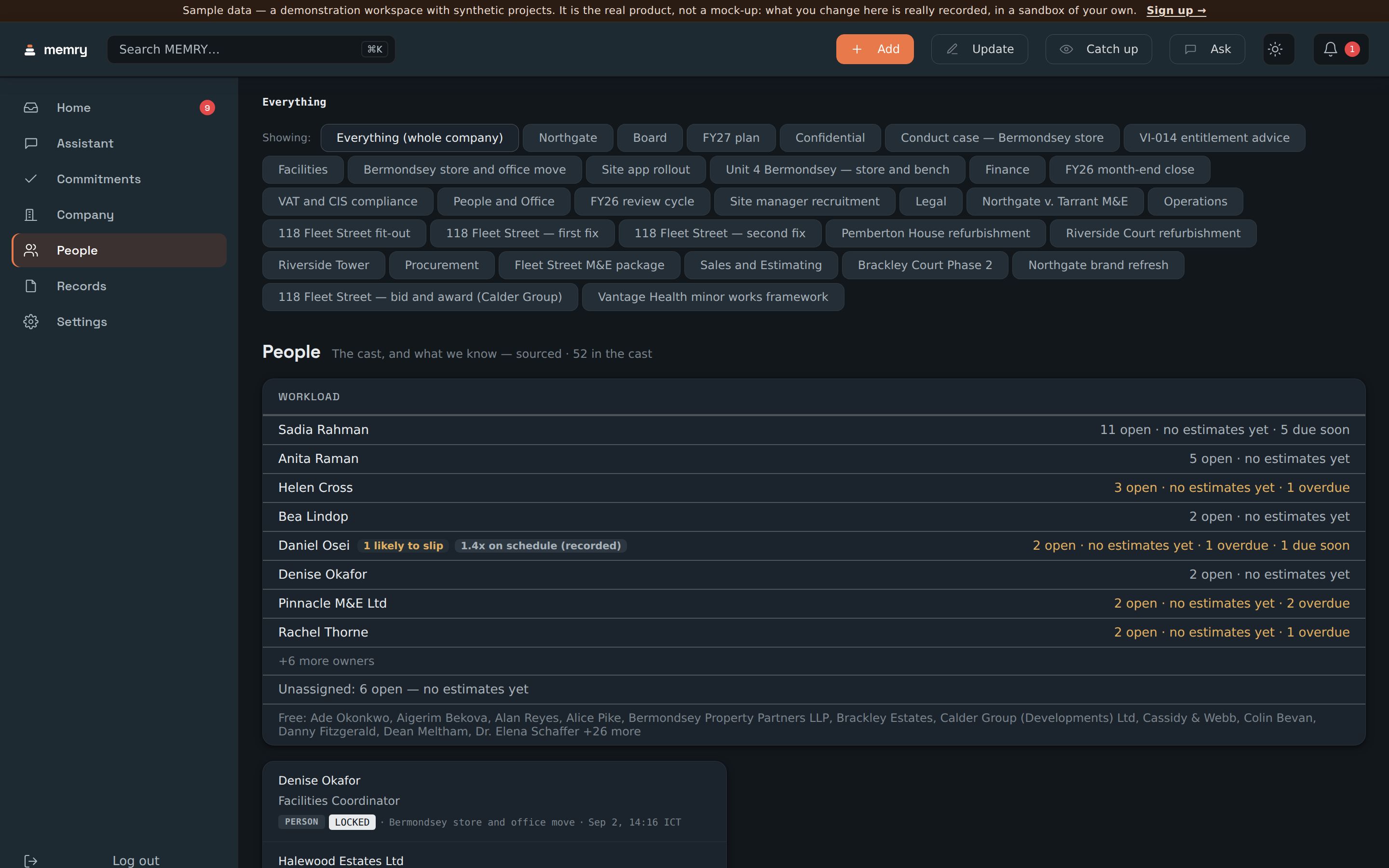 From the demo company
Who is holding what, across every engagement, with the reliability the product has actually earned the right to show — and “no estimates yet” where it has not.
What the general pack gives you
Deliberately unopinionated, meant to be shaped rather than obeyed.
One project templateBuilt
Broad by design, because a consultancy, an agency and an accountancy do not run a job the same way and a wrong-shaped template is worse than a plain one.
- Standard project
Template key: standard-project.
Two starter rules come with it: an overdue task is flagged once it is past its due date, and a due date that moves outward is raised rather than absorbed. Neither needs a model key, and either can be turned off.
The roles it starts withBuilt
Broad on purpose, for the same reason. These are the labels a first import can land on before you have decided your own.
- Owner/Founder
- Manager
- Team member
- Client/Customer
- Supplier
Rename them to whatever your firm actually calls these people. Memry keeps the ones you use.
The creep problem, in detail
Every practice loses money the same way, and it is never one big thing.
It is agreed verbally, then written vaguely
Somebody says yes on a call and follows up with a message that is friendlier than it is precise. Six weeks later two people remember two different agreements, and the one with the better memory of the email wins.
It never looks like a variation at the time
Each individual extra is small enough to absorb. The problem only exists in aggregate, which is exactly the form no human notices. A record that captures every one of them as it happens is the only version of the count that is ever right.
The engagement letter says something different
When a later message contradicts the letter, Memry raises it rather than letting the newer wording quietly become the agreement. You decide which governs, and the reason is stored with the decision.
And the person who knew leaves
The account manager who held the whole history in their head takes it with them. Everything Memry recorded stays, with its receipts, and the handover is a list rather than a hope.
Ignore the industry, watch the loop
The demo is a construction firm, and that is fine.
A promise found in a thread, two documents that disagree, a track record built from past estimates, a trail you can export. None of that is specific to a building site.
Explore the demo → No account. No invite code. Nothing to install.