For legal
Every position, back to the passage it came from.
A matter is a pile of documents that disagree with each other. Memry reads them, keeps each position with the sentence that supports it, and refuses to quietly replace one with another — so the work is checking positions rather than assembling them.
Where it earns its place in a matter
The work of a matter is holding a hundred small positions in your head at once, and knowing which document each one rests on.
A position keeps its authority
A term, a date, a figure or a specified minimum is recorded with the instrument and the clause it came from — not as a note that says roughly what somebody remembers it saying.
Instructed limits do not get overwritten
A settlement floor or an instruction that needs sign-off can be locked. A later document that contradicts it is parked and raised, never silently applied.
Contradictions are the deliverable
Two records that disagree are not an error to be cleaned up. They are usually the point of the matter, so the product keeps both and marks the disagreement.
Chronology without rebuilding it
Every fact carries when it was recorded and out of which document, so the sequence of what was known when is already assembled rather than reconstructed the week before a hearing.
Expert positions on the record
Who was retained, on what, and what they confirmed — held as records with sources, alongside everything else on the matter rather than in a separate folder.
Nothing enters without a person
Memry proposes; a person approves. No position is ever added to a matter on the software's own authority, which is the only way this is usable at all.
Two documents. Both true. Both kept.
Tarrant’s site record says the Level 3 second fix was handed over on time. Northgate’s handover log says it was released twelve days late.
Both are on the record in the demo matter, and neither one is wrong. A system that stores “the handover date” as a single field has to pick one and throw the other away — and the one it throws away is often the one that decides the case.
Memry keeps both, each with its own source, and marks that they disagree. Nothing is blocked; it is settled when somebody with the standing to settle it does, and the reasoning is stored with the answer.
The same mechanism holds the harder ones: a performance figure fixed in a schedule and later disputed as a looser “working figure”, a payment term varied by a second instrument where the variation was proposed and never countersigned, an instruction to plead a head of loss despite a limitation clause.
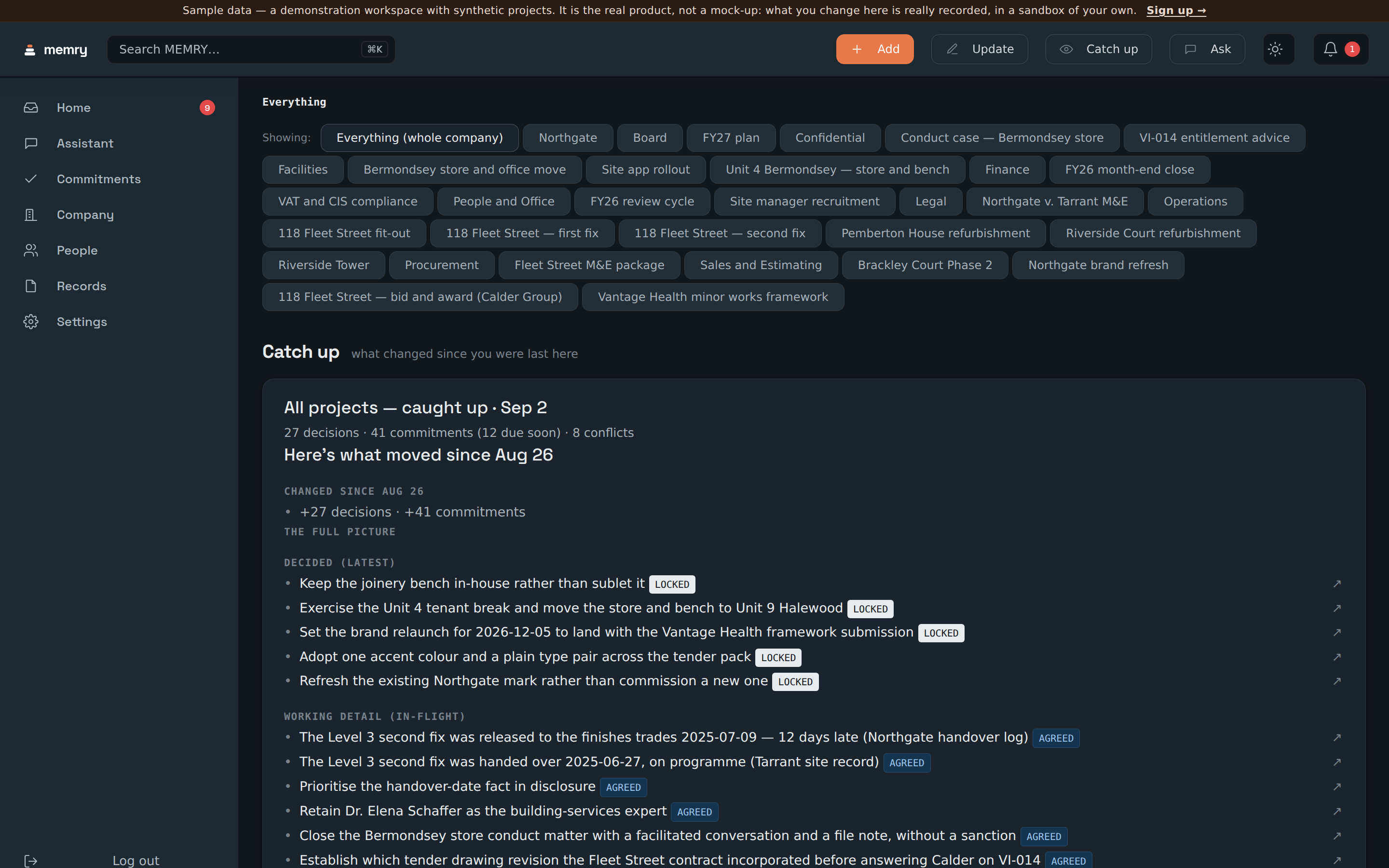 From the demo matter
What was decided, and what is still moving. The two Level 3 handover records sit together, both agreed, both kept.
What is there on day one
Pick Legal at signup and the firm is scaffolded around the way legal work runs. Rename any of it, remove what does not fit, or accept it as it stands.
Four matter typesBuilt
Each arrives with the stages and the prep work that kind of instruction actually needs, rather than an empty board somebody has to design first.
- Litigation matter
- Transaction / deal
- Advisory engagement
- Regulatory response
Template keys: litigation-matter, transaction-deal, advisory-engagement, regulatory-response.
The people on a matterBuilt
The roster arrives with the roles a firm works through, inside and outside the practice, so the first import has somewhere to land.
- Partner
- Associate
- Paralegal
- Client
- Opposing counsel
- Court/Tribunal
Rename any of them, add your own, and Memry keeps the ones you use.
A starting structure for the practice itself is scaffolded too, and Memry asks you to accept, rename or remove it before it counts as yours. It is a suggestion, not a model you have to live inside.
Discovery, handover, and the file after the file closes
Three moments where a matter's record is actually tested.
Finding the passage
Search runs across the records and the document bodies together, and every hit names the instrument it came out of. A position is one click from the sentence that supports it, in the file as it was received.
Prioritising what matters
Decisions about what to prioritise are themselves records with reasons attached, so the strategy on the file is legible to whoever picks it up — including the instruction not to accept or offer below a floor without sign-off.
When conduct of the matter moves
Everything the outgoing fee-earner was holding is already written down: the open promises, the positions, the documents behind them. Handover is a list, not a conversation you hope was complete.
Getting the file out
The full trail — who recorded what, when, and off which document — exports as CSV or JSON from inside the product, with no row cap and without a support ticket. A file you cannot take with you is not your file.
Separation between accounts is enforced underneath the interface rather than by the screens — the security page lists exactly which of those controls are built, and deliberately says nothing about the ones that are not.
A full matter, already running
Open the file.
The demo carries a live litigation matter with its instruments, its experts, its opposing side and its contradictions — including the two handover records that disagree. Yours to drive like a real account.
Explore the demo → No account. No invite code. Nothing to install.